
三角関数の代表的な微分公式である以下3種
\begin{eqnarray}
\displaystyle (\sin x)' &=& \cos x, \ \ \ (\cos x)' &=& -\sin x, \ \ \ (\tan x)' &=& \frac{1}{\cos^2 x}
\end{eqnarray}
について、これらを公式として覚えている方は多いと思いますが、「なぜ \(\sin x\) を微分すると \(\cos x\) になるの?」と疑問に思ったことはないでしょうか。
実はこれらの公式は、導関数の定義と三角関数の加法定理、さらに
\begin{eqnarray}
\displaystyle \lim_{h \to 0} \frac{\sin h}{h} = 1
\end{eqnarray}
を使うことで導出できます。
本記事では、sin・cos・tanの3つの微分公式を、導関数の定義から途中式を省略せずに証明していきます。
1. 三角関数の微分公式とは?
三角関数の微分公式とは、\(\sin x\)、\(\cos x\)、\(\tan x\) を微分したときに得られる以下の公式です。
三角関数の微分公式
\begin{eqnarray}
\displaystyle (\sin x)' &=& \cos x \\
\displaystyle (\cos x)' &=& -\sin x \\
\displaystyle (\tan x)' &=& \frac{1}{\cos^2 x}
\end{eqnarray}
これらは高校数学でよく使用する重要な微分公式ですが、単なる暗記公式ではありません。
これらの微分公式はいずれも、導関数の定義
\begin{eqnarray}
\displaystyle f'(x) = \lim_{h \to 0} \frac{f(x+h)-f(x)}{h}
\end{eqnarray}
から実際に導くことができます。
では、なぜ \(\sin x\) を微分すると \(\cos x\) になるのでしょうか?
以下では、導関数の定義から出発して、\(\sin x\)、\(\cos x\)、\(\tan x\) の微分公式を順番に証明していきます。
2. 三角関数の微分の証明に使う公式
三角関数の微分公式を証明するためには、いくつかの公式を使用します。
特に重要なのが、
「導関数の定義」「三角関数の加法定理」「三角関数の極限」
の3つです。
ここでは、証明に入る前に使用する公式を確認しておきましょう。
① 導関数の定義
関数 \(f(x)\) の導関数は
導関数の定義
\begin{eqnarray}
\displaystyle f'(x) = \lim_{h \to 0} \frac{f(x+h)-f(x)}{h}
\end{eqnarray}
と定義されます。
今回の証明では、\(\sin x\)、\(\cos x\)、\(\tan x\) をそれぞれ \(f(x)\) に代入し、この定義式から微分公式を導いていきます。
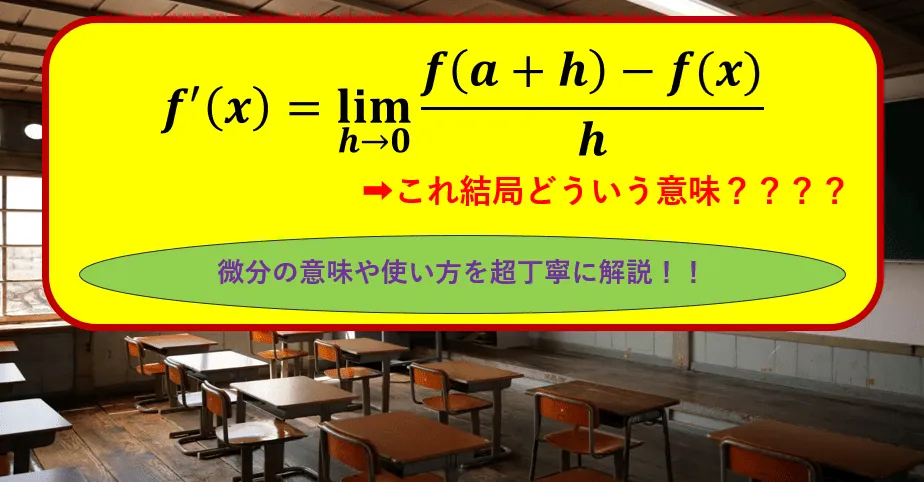
「そもそも、なぜこの式で微分できるの?」という方は、先に「微分とはなぜ接線の傾きになるのか?」の記事を確認してみてください。
-
-
微分とは? なぜ微分すると接線の傾きが
求められるのかをわかりやすく解説「微分すると接線の傾きが求められる」と習ったけれど、 「そもそも、なぜ微分すると傾きが求められるの?」 と疑問に思ったことはないでしょうか。 微分とは、簡単にいうと「ある瞬間における変化の割合」を求め ...
② 三角関数の加法定理
三角関数の微分を導関数の定義から証明すると、
\begin{eqnarray}
\displaystyle \sin(x+h)
\end{eqnarray}
や
\begin{eqnarray}
\displaystyle \cos(x+h)
\end{eqnarray}
といった式が現れます。
そこで使用するのが、三角関数の加法定理です。
三角関数の加法定理の公式
\begin{eqnarray}
\displaystyle \sin(a+b) &=& \sin a\cos b + \cos a\sin b \\
\displaystyle \cos(a+b) &=& \cos a\cos b - \sin a\sin b \\
\displaystyle \tan(a+b) &=& \frac{\tan a + \tan b}{1 - \tan a\tan b}
\end{eqnarray}
例えば、\(\sin(x+h)\) であれば
\begin{eqnarray}
\displaystyle \sin(x+h) = \sin x\cos h + \cos x\sin h
\end{eqnarray}
と変形できます。
この変形が、\(\sin x\) の微分公式を導く上で重要になります。
-
-
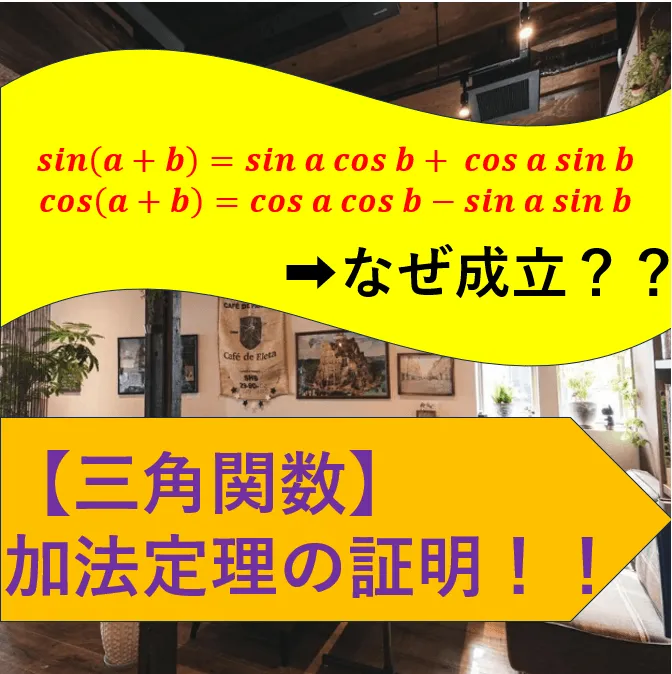
三角関数の加法定理とは?
公式・使い方・証明をわかりやすく解説2026/9/29
三角関数には、2つの角の和や差を扱うための「加法定理」と呼ばれる重要な公式があります。 代表的なものが、 \begin{eqnarray}\displaystyle \sin(\alpha+\beta ...
③ 三角関数の基本公式
式変形の途中では、以下の三角関数の基本公式も使用します。
三角関数の基本公式
\begin{eqnarray}
\displaystyle \sin^2 \theta+\cos^2 \theta=1 \\
\displaystyle \frac{\sin \theta}{\cos \theta}=\tan \theta \\
\displaystyle 1+\tan^2 \theta=\frac{1}{\cos^2 \theta}
\end{eqnarray}
特に、
\begin{eqnarray}
\displaystyle \sin^2 \theta+\cos^2 \theta=1
\end{eqnarray}
から得られる
\begin{eqnarray}
\displaystyle \cos^2 \theta-1=-\sin^2 \theta
\end{eqnarray}
は、\(\sin x\)、\(\cos x\) の微分を証明する時に使用します。
-
-
三角関数とは?|
sin・cos・tan の定義・性質・使い方を
わかりやすく解説三角関数とは、角度 \(\theta\) によって値が決まる関数で、代表的なものに \begin{eqnarray}\displaystyle \sin\theta, \quad \cos\theta ...
④ 三角関数の極限
そして、今回の証明で特に重要なのが三角関数の極限です。
証明で使用する三角関数の極限
\begin{eqnarray}
\displaystyle \lim_{h \to 0} \frac{\sin h}{h} = 1 \\
\displaystyle \lim_{h \to 0} \sin h = 0 \\
\displaystyle \lim_{h \to 0} \cos h = 1
\end{eqnarray}
なかでも、
\begin{eqnarray}
\displaystyle \lim_{h \to 0} \frac{\sin h}{h} = 1
\end{eqnarray}
は、\(\sin x\) や \(\cos x\) の微分公式を導くための重要な極限です。
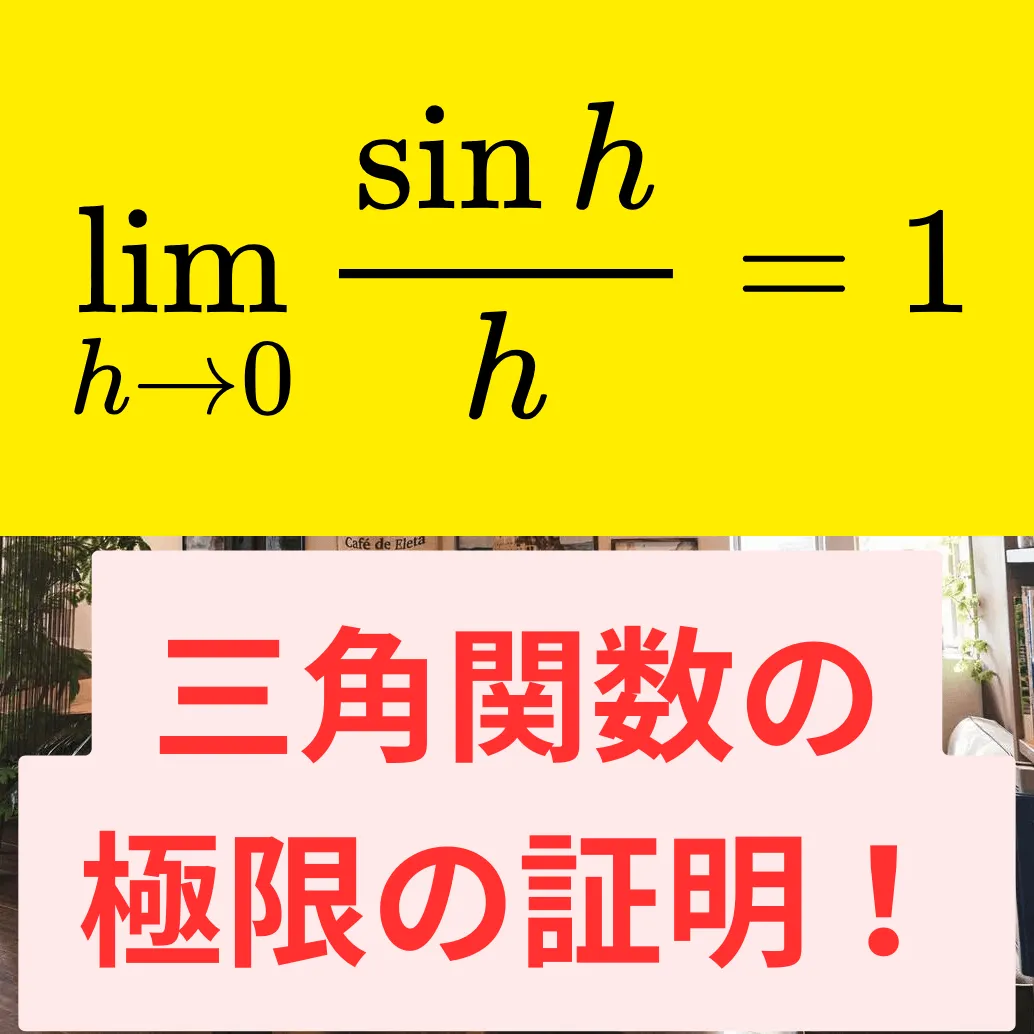
この極限がなぜ 1 になるのかについては、図形の面積とはさみうちの原理を使って別記事で詳しく証明しています。
-
-
sinx/xの極限が1になる理由|
はさみうちの原理でわかりやすく証明2026/8/24
三角関数で重要な極限の一つに、 \begin{eqnarray}\displaystyle \lim_{x \to 0} \frac{\sin x}{x} = 1\end{eqnarray} がありま ...
以上の公式を使って、まずは「なぜ \(\sin x\) を微分すると \(\cos x\) になるのか?」から証明していきましょう。
3. \(\sin x\) を微分すると \(\cos x\) になることの証明
まずは、
\begin{eqnarray}
\displaystyle (\sin x)' = \cos x
\end{eqnarray}
が成り立つことを、導関数の定義から証明します。
\(f(x) = \sin x\) と定義する。微分の定義より、
\begin{eqnarray}
f'(x) &=& \displaystyle \lim_{h \to 0} \frac{f(x+h)-f(x)}{h} \\
&=& \displaystyle \lim_{h \to 0} \frac{\color{red}{\sin(x+h)}-\sin x}{h}
\end{eqnarray}
三角関数の加法定理(\(\sin(a+b) = \sin a\cos b + \cos a\sin b\))より、
\begin{eqnarray}
f'(x) &=& \displaystyle \lim_{h \to 0} \frac{\color{red}{\sin x\cos h+\cos x\sin h}-\sin x}{h} \\
&=& \displaystyle \lim_{h \to 0} \frac{\sin x(\cos h-1)+\cos x\sin h}{h} \\
&=& \displaystyle \lim_{h \to 0} \left[\frac{\sin x(\cos h-1)}{h}+\cos x・\frac{\sin h}{h} \right] \\
&=& \displaystyle \lim_{h \to 0} \left[\frac{\sin x(\cos h-1)(\cos h+1)}{h(\cos h+1)}+\cos x・\frac{\sin h}{h}\right] \\
&=& \displaystyle \lim_{h \to 0} \left[\frac{\sin x(\color{blue}{\cos^2 h-1})}{h(\cos h+1)}+\cos x・\frac{\sin h}{h}\right] \\
\end{eqnarray}
三角関数の基本公式(\(\sin^2 \theta+\cos^2 \theta=1\))より、
\begin{eqnarray}
f'(x) &=& \displaystyle \lim_{h \to 0} \left[\frac{\sin x(\color{blue}{-\sin^2 h})}{h(\cos h+1)}+\cos x・\frac{\sin h}{h}\right] \\
&=& \displaystyle \lim_{h \to 0} \left[-\frac{\sin x(\sin^2 h)}{h^2(\cos h+1)}・h+\cos x・\frac{\sin h}{h}\right] \\
&=& \displaystyle \lim_{h \to 0} \left[-\frac{\sin x}{\color{green}{\cos h}+1}・\left(\color{green}{\frac{\sin h}{h}} \right)^2・h+\cos x・\color{green}{\frac{\sin h}{h}}\right]
\end{eqnarray}
三角関数の極限(\(\displaystyle \lim_{h \to 0} \frac{\sin h}{h} = 1\))と(\(\displaystyle \lim_{h \to 0} \cos h = 1\))より、
\begin{eqnarray}
f'(x) &=& \displaystyle \left[-\frac{\sin x}{\color{green}{2}}・\color{green}{1}^2・0+\cos x・\color{green}{1} \right] \\
&=& \displaystyle \cos x
\end{eqnarray}
以上より、
\begin{equation}
f'(x) = (\sin x)' = \cos x
\end{equation}
が導出できます。
4. \(\cos x\) を微分すると \(-\sin x\) になることの証明
\(f(x) = \cos x\) と定義する。
\begin{eqnarray}
f'(x) &=& \displaystyle \lim_{h \to 0} \frac{f(x+h)-f(x)}{h} \\
&=& \displaystyle \lim_{h \to 0} \frac{\color{red}{\cos(x+h)}-\cos x}{h}
\end{eqnarray}
三角関数の加法定理(\(\cos(a+b) = \cos a\cos b - \sin a\sin b\))より、
\begin{eqnarray}
f'(x) &=& \displaystyle \lim_{h \to 0} \frac{\color{red}{\cos x\cos h-\sin x\sin h}-\cos x}{h} \\
&=& \displaystyle \lim_{h \to 0} \frac{\cos x(\cos h-1)-\sin x\sin h}{h} \\
&=& \displaystyle \lim_{h \to 0} \left[\frac{\cos x(\cos h-1)}{h}-\sin x・\frac{\sin h}{h} \right] \\
&=& \displaystyle \lim_{h \to 0} \left[\frac{\cos x(\cos h-1)(\cos h+1)}{h(\cos h+1)}-\sin x・\frac{\sin h}{h}\right] \\
&=& \displaystyle \lim_{h \to 0} \left[\frac{\cos x(\color{blue}{\cos^2 h-1})}{h(\cos h+1)}-\sin x・\frac{\sin h}{h}\right]
\end{eqnarray}
三角関数の基本公式(\(\sin^2 \theta+\cos^2 \theta=1\))より、
\begin{eqnarray}
f'(x) &=& \displaystyle \lim_{h \to 0} \left[\frac{\cos x(\color{blue}{-\sin^2 h})}{h(\cos h+1)}-\sin x・\frac{\sin h}{h}\right] \\
&=& \displaystyle \lim_{h \to 0} \left[-\frac{\cos x(\sin^2 h)}{h^2(\cos h+1)}・h-\sin x・\frac{\sin h}{h}\right] \\
&=& \displaystyle \lim_{h \to 0} \left[-\frac{\cos x}{\color{green}{\cos h}+1}・\left(\color{green}{\frac{\sin h}{h}} \right)^2・h-\sin x・\color{green}{\frac{\sin h}{h}}\right]
\end{eqnarray}
三角関数の極限(\(\displaystyle \lim_{h \to 0} \frac{\sin h}{h} = 1\))と(\(\displaystyle \lim_{h \to 0} \cos h = 1\))より、
\begin{eqnarray}
f'(x) &=& \displaystyle \left[-\frac{\cos x}{\color{green}{2}}・\color{green}{1}^2・0-\sin x・\color{green}{1} \right] \\
&=& \displaystyle -\sin x
\end{eqnarray}
以上より、
\begin{equation}
f'(x) = (\cos x)' = -\sin x
\end{equation}
が導出できます。
5. \(\tan x\) を微分すると \(\displaystyle \frac{1}{\cos^2 x}\) になることの証明
\(f(x) = \tan x\) と定義する。
※ただし、\(\tan x\) が定義される範囲で考えます。
\begin{eqnarray}
f'(x) &=& \displaystyle \lim_{h \to 0} \frac{f(x+h)-f(x)}{h} \\
&=& \displaystyle \lim_{h \to 0} \frac{\color{red}{\tan(x+h)}-\tan x}{h}
\end{eqnarray}
三角関数の加法定理(\(\displaystyle \tan(a+b) = \frac{\tan a + \tan b}{1 - \tan a\tan b}\))より、
\begin{eqnarray}
f'(x) &=& \displaystyle \lim_{h \to 0} \frac{\color{red}{\frac{\tan x + \tan h}{1-\tan x\tan h}}-\tan x}{h} \\
&=& \displaystyle \lim_{h \to 0} \frac{\tan x + \tan h-\tan x(1-\tan x\tan h)}{h(1-\tan x\tan h)} \\
&=& \displaystyle \lim_{h \to 0} \frac{\color{blue}{\tan h}+\tan^2 x\color{blue}{\tan h}}{h(1-\tan x\color{blue}{\tan h})}
\end{eqnarray}
三角関数の基本公式(\(\displaystyle \frac{\sin \theta}{\cos \theta}=\tan \theta\))より、
\begin{eqnarray}
f'(x) &=& \displaystyle \lim_{h \to 0} \frac{\color{blue}{\frac{\sin h}{\cos h}}+\tan^2 x・\color{blue}{\frac{\sin h}{\cos h}}}{h(1-\tan x・\color{blue}{\frac{\sin h}{\cos h}})} \\
&=& \displaystyle \lim_{h \to 0} \frac{\sin h+\tan^2 x\sin h}{h(\cos h-\tan x\sin h)} \\
&=& \displaystyle \lim_{h \to 0} \frac{\sin h(1+\tan^2 x)}{h(\cos h-\tan x\sin h)} \\
&=& \displaystyle \lim_{h \to 0} \left[\color{green}{\frac{\sin h}{h}}・\frac{1}{\color{green}{\cos h}-\tan x\color{green}{\sin h}}・(1+\tan^2 x) \right]
\end{eqnarray}
三角関数の極限(\(\displaystyle \lim_{h \to 0} \frac{\sin h}{h} = 1\))と(\(\displaystyle \lim_{h \to 0} \cos h = 1\))と(\(\displaystyle \lim_{h \to 0} \sin h = 0\))より、
\begin{eqnarray}
f'(x) &=& \displaystyle \color{green}{1}・\frac{1}{\color{green}{1}-\tan x・\color{green}{0}}・(1+\tan^2 x) \\
&=& \displaystyle 1+\tan^2 x \\
&=& \displaystyle \frac{1}{\cos^2 x}
\end{eqnarray}
※ただし、最後の式変形では三角関数の基本公式(\(1+\tan^2 \theta=\displaystyle \frac{1}{\cos^2 \theta}\))を用いた。
以上より、
\begin{equation}
f'(x) = (\tan x)' = \frac{1}{\cos^2 x}
\end{equation}
が導出できます。
■まとめ
本記事では、三角関数の代表的な微分公式
\begin{eqnarray}
\displaystyle (\sin x)' &=& \cos x \\
\displaystyle (\cos x)' &=& -\sin x \\
\displaystyle (\tan x)' &=& \frac{1}{\cos^2 x}
\end{eqnarray}
の3つを、導関数の定義から証明しました。
三角関数の微分公式を証明するうえで特に重要なのが、
\begin{eqnarray}
\displaystyle \lim_{h \to 0} \frac{\sin h}{h} = 1
\end{eqnarray}
という極限と、三角関数の加法定理です。
例えば \(\sin x\) の微分では、導関数の定義
\begin{eqnarray}
\displaystyle f'(x) = \lim_{h \to 0} \frac{f(x+h)-f(x)}{h}
\end{eqnarray}
に \(f(x)=\sin x\) を代入し、加法定理によって \(\sin(x+h)\) を展開します。
そこから式変形を行い、
\begin{eqnarray}
\displaystyle \lim_{h \to 0} \frac{\sin h}{h} = 1
\end{eqnarray}
を利用することで、
\begin{eqnarray}
\displaystyle (\sin x)' = \cos x
\end{eqnarray}
を導くことができます。
同様に、\(\cos x\)、\(\tan x\) についても導関数の定義から微分公式を導出できます。
三角関数の微分公式は単に結果を覚えるだけでなく、「導関数の定義→加法定理→三角関数の極限」という流れから導けることも押さえておきましょう。
関連記事
▶ 微分とはなぜ接線の傾きになるのか?定義からわかりやすく解説
→ 導関数の定義から復習したい人向け
▶ sinx/xの極限が1になる理由|はさみうちの原理でわかりやすく証明
→ 今回の証明で使った重要な極限を詳しく知りたい人向け
▶ 三角関数とは?基本から定義・性質・使い方まで解説
→ sin・cos・tanの基本から復習したい人向け
▶ 三角関数の加法定理を証明|なぜ公式が成り立つのか?
→ 今回使用した加法定理の証明を知りたい人向け