【18°】は準有名角と呼ばれています。
これらの角度は「有名角」ではありませんが、
倍角公式や三倍角公式を利用することで、根号を含む形で正確に求めることができます。
本記事では三角関数の公式を利用しながら、sin18°・cos18°・tan18°の値を順を追って丁寧に導出していきます。
できるだけ省略せず解説しているので、導出過程を確認したい方はぜひ参考にしてみてください。
本記事で導出する sin18°、cos18°、tan18° の値
\begin{eqnarray}
\displaystyle \sin18^{\circ}&=&\frac{\sqrt{5}-1}{4} \\
\displaystyle \cos18^{\circ}&=&\frac{\sqrt{10+2\sqrt{5}}}{4} \\
\displaystyle \tan18^{\circ}&=&\frac{1}{\sqrt{5+2\sqrt{5}}}
\end{eqnarray}
目次
■三角関数の倍角・三倍角の公式の復習
まずは、倍角・三倍角の公式の復習から始めましょう。
倍角・三倍角の公式は、以下となります。
三角関数の倍角・三倍角の公式(復習)
\begin{eqnarray}
\displaystyle \sin 2\theta &=& 2\sin \theta \cos \theta \\
\displaystyle \cos 2\theta &=& \cos^2 \theta - \sin^2 \theta \\
\displaystyle \tan 2\theta &=& \frac{2\tan \theta}{1-\tan^2 \theta} \\
\\
\displaystyle \sin 3\theta &=& - 4\sin^3 \theta + 3\sin \theta \\
\displaystyle \cos 3\theta &=& 4\cos^3 \theta - 3\cos \theta \\
\displaystyle \tan 3\theta &=& \frac{3\tan \theta - \tan^3 \theta}{1-3\tan^2 \theta}
\end{eqnarray}
この倍角・三倍角の公式は暗記してもいいですが、三角関数の加法定理さえ覚えていれば、暗記せずともその場で導出できます。
詳細については以下の過去記事でまとめていますので、是非参考にしてみて下さい。
-
-
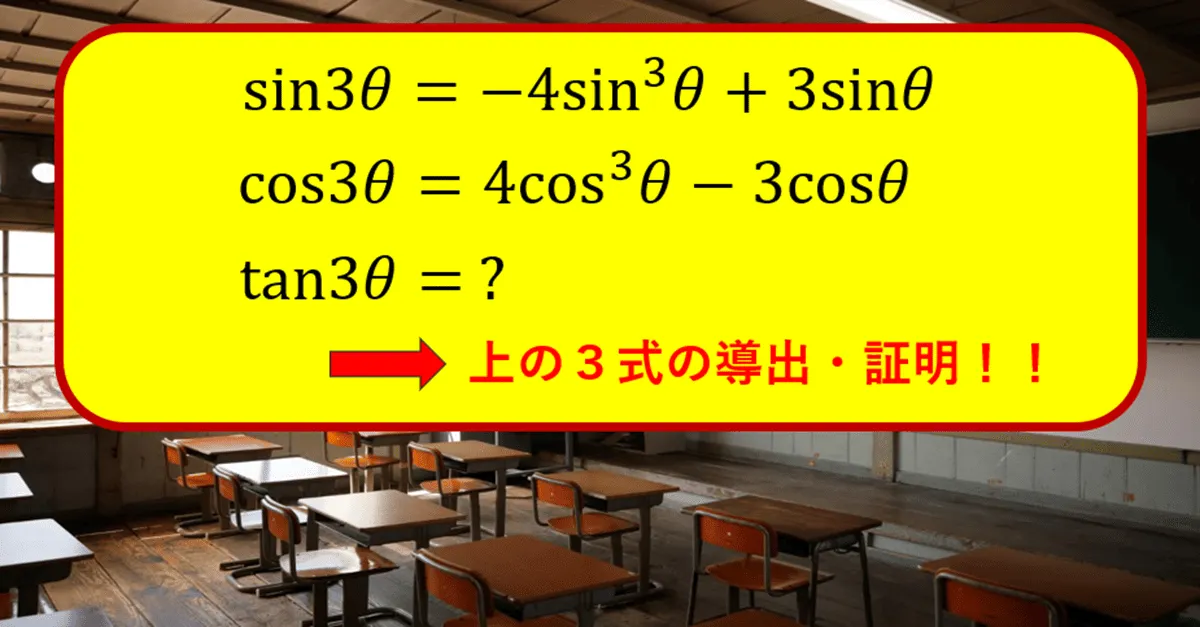
三角関数の倍角公式・三倍角公式の導出|
加法定理から証明三角関数には「倍角公式」や「三倍角公式」と呼ばれる重要な公式があります。 これらの公式は計算でよく使われますが、どのようにして導出されるのかを理解しているでしょうか? 実はこれらの公式は、三角関数の加 ...
■ \(\sin18^{\circ}\) の導出
\(\sin18^{\circ}\) の値を導出は、以下の関係式を利用してやれば実は簡単に求まる。
\begin{eqnarray}
\displaystyle \sin54^{\circ}=\cos36^{\circ} \tag{1}\\
\end{eqnarray}
(1)式は、以下の関係式が成立することを利用したものになります。
\begin{eqnarray}
\displaystyle \sin(90^{\circ}-\theta)=\cos\theta \\
\end{eqnarray}
この関係式は「三角関数の加法定理」から簡単に証明できます。
ここで、\(\theta=18^{\circ}\) とおくと、(1)式は
\begin{eqnarray}
\displaystyle \color{red}{\sin3\theta}=\color{blue}{\cos2\theta} \tag{2}\\
\end{eqnarray}
のような形になる。
次に、(2)式の左辺と右辺それぞれを、\(\sin\theta\) で表すことを考える。
まず(2)式の左辺は、三倍角の公式を利用して、
\begin{eqnarray}
\displaystyle \color{red}{\sin3\theta}=-4\sin^3\theta+3\sin\theta \tag{3}\\
\end{eqnarray}
となる。次に(2)式の右辺は、倍角の公式を利用して、
\begin{eqnarray}
\displaystyle \color{blue}{\cos2\theta}=1-2\sin^2\theta \tag{4}\\
\end{eqnarray}
となるので、(3)式、(4)式を(2)式に代入すると、
\begin{eqnarray}
\displaystyle -4\sin^3\theta+3\sin\theta=1-2\sin^2\theta \tag{5}\\
\end{eqnarray}
(5)式は『\(\sin\theta\) の3次方程式』になっているため解くことができる。
「三倍角の公式とか倍角の公式って何だっけ?」という方は、こちらに説明がありますのでよろしければお立ち寄り下さい!
\(\sin\theta\) のままだと見づらいので、\(x=\sin\theta\) とおいて(5)式を解いていくと、
\begin{eqnarray}
\displaystyle &&-4x^3+3x=1-2x^2 \\
\displaystyle \Rightarrow &\ \ &4x^3-2x^2-3x+1=0 \\
\displaystyle \Rightarrow &\ \ &(x-1)(4x^2+2x-1)=0 \tag{6}\\
\end{eqnarray}
「\(4x^2+2x-1\)」の項は、解の公式を利用して
\begin{eqnarray}
\displaystyle x&=&\frac{-2\pm\sqrt{4+16}}{8} \\
\displaystyle &=&\frac{-2\pm2\sqrt{5}}{8} \\
\displaystyle &=&\frac{-1\pm\sqrt{5}}{4} \\
\end{eqnarray}
となるため、(6)式の解は
\begin{eqnarray}
\displaystyle x=1,\ \frac{-1\pm\sqrt{5}}{4} \tag{7}
\end{eqnarray}
のように3種類出てくる。
ここで、元々 \(x=\sin18^\circ\) だったことを思い出すと、\(x\) の値は
\begin{eqnarray}
\displaystyle 0<x<1 \tag{8}
\end{eqnarray}
を満たさなければならないことは明白である。
(7)の3種の解のうち、(8)の定義域を満たすものは以下しか存在しない。
\begin{eqnarray}
\displaystyle x=\frac{-1+\sqrt{5}}{4}
\end{eqnarray}
よって、最終的に \(\sin18^{\circ}\) の値は、
\begin{eqnarray}
\displaystyle \sin18^\circ=\frac{\sqrt{5}-1}{4} \tag{9}
\end{eqnarray}
となり、これが答えとなる。
ちょっとここまで長くなってしまいましたが、次の \(\cos18^\circ\) と \(\tan18^\circ\) の導出は、たった今求めた \(\sin18^\circ\) の値を利用すればすぐに求まりますので、安心して下さい!
■ \(\cos18^{\circ}\) の導出
これは先ほど求めた \(\sin18^{\circ}\) と、三角関数の基本公式(\(\sin^2\theta+\cos^2\theta=1\))を利用すれば求められる。
また、\(0<\cos18^{\circ}<1\) であることに注意して、計算していくと
\begin{eqnarray}
\displaystyle \cos18^\circ&=&\sqrt{1-\sin^2 18^\circ} \\
\displaystyle &=&\sqrt{1-\left(\frac{\sqrt{5}-1}{4}\right)^2} \\
\displaystyle &=&\sqrt{1-\frac{6-2\sqrt{5}}{16}} \\
\displaystyle &=&\sqrt{\frac{10+2\sqrt{5}}{16}} \\
\displaystyle &=&\frac{\sqrt{10+2\sqrt{5}}}{4} \tag{10}\\
\end{eqnarray}
となり、これが答えとなる。
■ \(\tan18^{\circ}\) の導出
先ほど求めた \(\sin18^{\circ}\) と \(\cos18^{\circ}\) を、三角関数の基本公式(\(\displaystyle \tan\theta=\frac{\sin\theta}{\cos\theta}\))に当てはめて求めていくと、
\begin{eqnarray}
\displaystyle \tan18^\circ&=&\frac{\sin18^\circ}{\cos18^\circ} \\
\displaystyle &=&\frac{\frac{\sqrt{5}-1}{4}}{\frac{\sqrt{10+2\sqrt{5}}}{4}}・\color{red}{\frac{4}{4}} \\
\displaystyle &=&\frac{\sqrt{5}-1}{\sqrt{10+2\sqrt{5}}}・\color{red}{\frac{\sqrt{5}+1}{\sqrt{5}+1}} \tag{11}\\
\displaystyle &=&\frac{5-1}{\sqrt{10+2\sqrt{5}}\sqrt{(\sqrt{5}+1)^2}} \\
\displaystyle &=&\frac{4}{\sqrt{10+2\sqrt{5}}\sqrt{6+2\sqrt{5}}} \\
\displaystyle &=&\frac{4}{\sqrt{(10+2\sqrt{5})(6+2\sqrt{5})}} \\
\displaystyle &=&\frac{4}{\sqrt{80+32\sqrt{5}}} \\
\displaystyle &=&\frac{4}{4\sqrt{5+2\sqrt{5}}} \\
\displaystyle &=&\frac{1}{\sqrt{5+2\sqrt{5}}} \tag{12} \\
\end{eqnarray}
となり、これが答えとなる。
(11)式で分子の有理化を行うことで、(12)式のようなシンプルな形にできるのです!
■sin18°、cos18°、tan18°の値の正当性の確認
倍角・三倍角の公式を利用することで、sin18°、cos18°、tan18° の値は以下の通り求めることができました。
先ほど導出した sin18°、cos18°、tan18° の値
\begin{eqnarray}
\displaystyle \sin18^{\circ}&=&\frac{\sqrt{5}-1}{4} \tag{13} \\
\displaystyle \cos18^{\circ}&=&\frac{\sqrt{10+2\sqrt{5}}}{4} \tag{14} \\
\displaystyle \tan18^{\circ}&=&\frac{1}{\sqrt{5+2\sqrt{5}}} \tag{15}
\end{eqnarray}
ただ、これらの値って、本当に合っているのでしょうか?
それを確認するため、以下の値を(13)式~(15)式に当てはめてみて、最終的に他サイトの三角関数表を参照して、上式の正当性の確認を行ってみましょう。
sin18°、cos18°、tan18°の値(小数形式)
sin18°の値(小数形式)
\begin{eqnarray}
\displaystyle \sin18^{\circ}&=&\frac{\sqrt{5}-1}{4} \\
&≒& \frac{2.236067-1}{4} \\
&=& \frac{1.236067}{4} \\
&≒& 0.309016 \tag{16}
\end{eqnarray}
cos18°の値(小数形式)
\begin{eqnarray}
\displaystyle \cos18^{\circ}&=&\frac{\sqrt{10+2\sqrt{5}}}{4} \\
&≒& \frac{\sqrt{10+2 \cdot 2.236067}}{4} \\
&=& \frac{\sqrt{10+4.472134}}{4} \\
&=& \frac{3.804225}{4} \\
&≒& 0.951056 \tag{17}
\end{eqnarray}
tan18°の値(小数形式)
\begin{eqnarray}
\displaystyle \tan18^{\circ}&=&\frac{1}{\sqrt{5+2\sqrt{5}}} \\
\displaystyle &≒& \frac{1}{\sqrt{5+2 \cdot 2.236067}} \\
\displaystyle &=& \frac{1}{\sqrt{5+4.472134}} \\
\displaystyle &=& \frac{1}{\sqrt{9.472134}} \\
\displaystyle &≒& \frac{1}{3.077683} \\
\displaystyle &≒& 0.324919 \tag{18}
\end{eqnarray}
国立大学が公表している三角関数表の値との比較
千葉大学理学部数学・情報物理学科の公式HPに載っている三角関数表を参考に、
上で求めた(16)式~(18)式の値が一致しているか、確認していきます。
上記サイト内では、sin18°、cos18°、tan18° の値はそれぞれ以下の通り記載されています。
千葉大学が公表している sin18°、cos18°、tan18° の値
\begin{eqnarray}
\displaystyle \sin 18^\circ &=& 0.3090 \\
\displaystyle \cos 18^\circ &=& 0.9511 \\
\displaystyle \tan 18^\circ &=& 0.3249
\end{eqnarray}
(16)式~(18)式の値と比較してみると、ほぼほぼ一致した結果となっていることがわかります。
■まとめ
本記事では、三角関数の公式を利用して sin18°・cos18°・tan18° の値を導出しました。
途中の計算では、倍角公式や三倍角公式などの三角関数の基本公式を利用することで、18°のような一見中途半端な角度でも、根号を含む形で正確な値を求められることが分かりました。
三角関数では今回の18°のように、公式を組み合わせることで様々な角度の値を導くことができます。公式を単に暗記するだけでなく、どのように導出されるのかを理解しておくことで、より深く三角関数を理解できるようになります。
本サイトでは他にも、三角関数の公式の導出や様々な角度の値の求め方について解説していますので、興味のある方はぜひ他の記事も参考にしてみてください。